
CORPSE FLOWER BLOOMS TWICE IN CALIFORNIA THIS WEEK
A corpse flower bloom in California drew crowds who skipped work to see it. Here's why Titan Arum flowering is so rare and what it smells like.
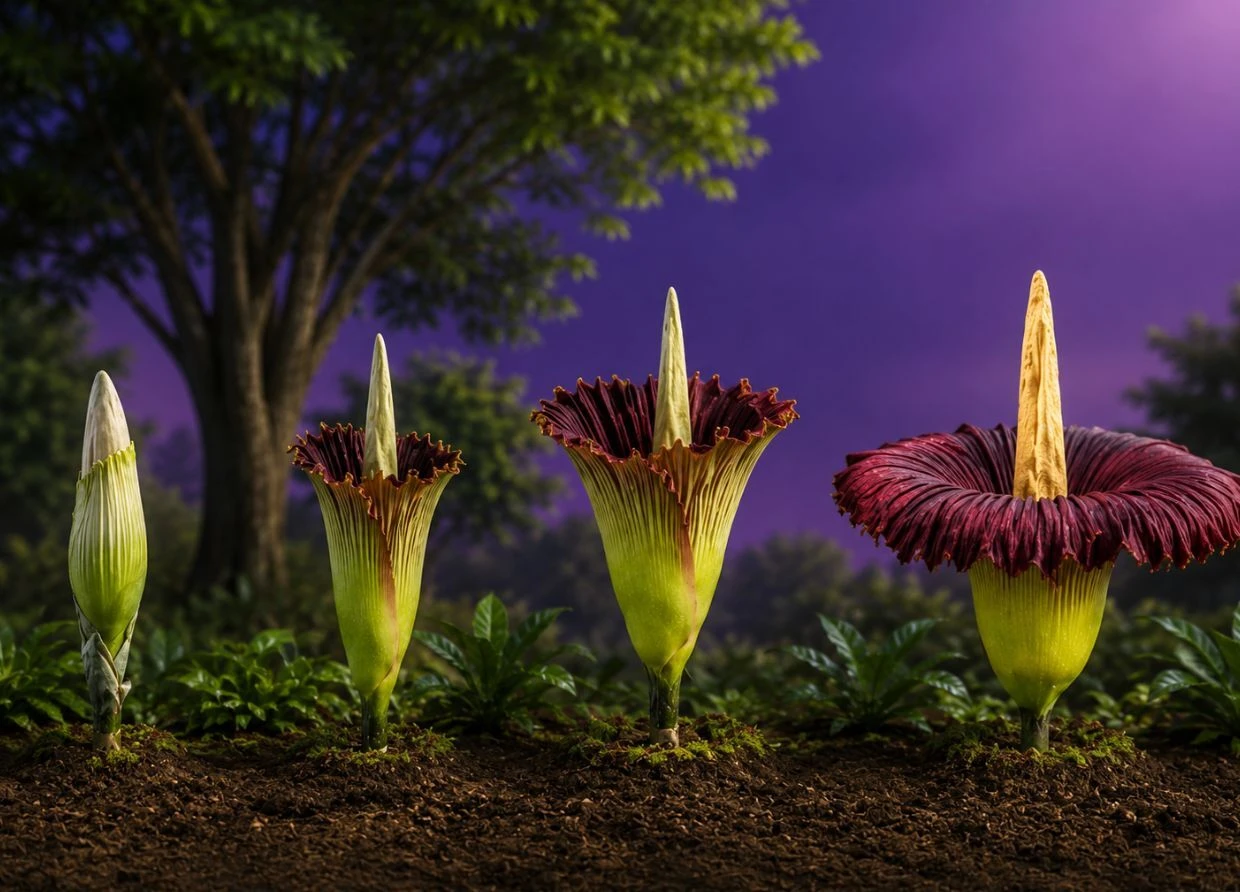





A six-foot maroon flower that smells like a dead body just opened in a greenhouse outside Los Angeles, and people took the day off work to stand in line for it.
At a glance:
- 2 plants bloomed days apart Odora and Odorysseus
- 2+ feet tall at full height
- 24–48 hours is the entire bloom window
- 43 mature Titan Arums in the collection, only 29 public blooms since 1999
The corpse flower bloom in California happened at The Huntington Library, Art Museum, and Botanical Gardens in San Marino, near Pasadena. Two Titan Arums (Amorphophallus titanum) nicknamed Odora and Odorysseus opened inside the Rose Hills Foundation Conservatory for Botanical Science in mid-July 2026. Each bloom stayed at peak for roughly 24 hours before starting to fade. Entry was included with regular garden admission, and a livestream ran on The Huntington's website for people who couldn't make it in person.
Why does a flower smell like a corpse?
It's not an accident. The Titan Arum, native to the rainforests of western Sumatra, Indonesia, produces its stench specifically to attract pollinators like carrion beetles and flies insects that normally feed on dead animals. Staff and visitors on-site described the smell as somewhere between rotten eggs, dirty gym socks, and decaying flesh. It's not subtle, and that's the point.
How rare is this, really?
Rarer than most people assume. A single Titan Arum can take years, sometimes over a decade, between flowerings, and the bloom itself burns out within two days. The Huntington maintains one of the largest Titan Arum collections in North America, with more than 43 mature plants on-site — and even with that scale, the institution has only publicly exhibited 29 corpse flower blooms since acquiring its first specimen in 1999. Two blooming within the same week is close to a coin-flip event.
"To have one Corpse Flower bloom is special — to have two at the same time is extraordinary," said Nicole Cavender, the Telleen/Jorgensen Director of the Botanical Gardens at The Huntington.
What makes the plant so hard to grow?
Size and patience. The endangered species can grow more than 12 feet tall and, during peak growth, adds as much as six inches in a single day a speed most houseplants never hit in a year. Most of the plants in The Huntington's collection descend from a single specimen that bloomed in 2002, grown out over two decades by staff who hand-pollinate each flower with a brush the moment it opens, because the bloom window is too short to leave to chance.
Why did people skip work to see it?
Because you genuinely cannot schedule around it. Corpse flowers don't send a save-the-date botanists watch the spathe for days, and the actual opening can happen overnight. For plant lovers, missing a 24-hour window means waiting years for the next one, which is exactly why lines formed outside the conservatory on a random Tuesday morning.
The counterintuitive part: this isn't a wild jungle event. It's happening in a controlled greenhouse in suburban Los Angeles, propagated by a conservation program trying to keep an endangered Sumatran species alive outside its shrinking native habitat.