A SKY FULL OF LIGHT: HOW BOROBUDUR LIT UP THE NIGHT FOR WAISAK 2570
Thousands of lanterns lit the night sky above Candi Borobudur on May 31. Here's everything that happened at Festival Lampion Waisak 2026.
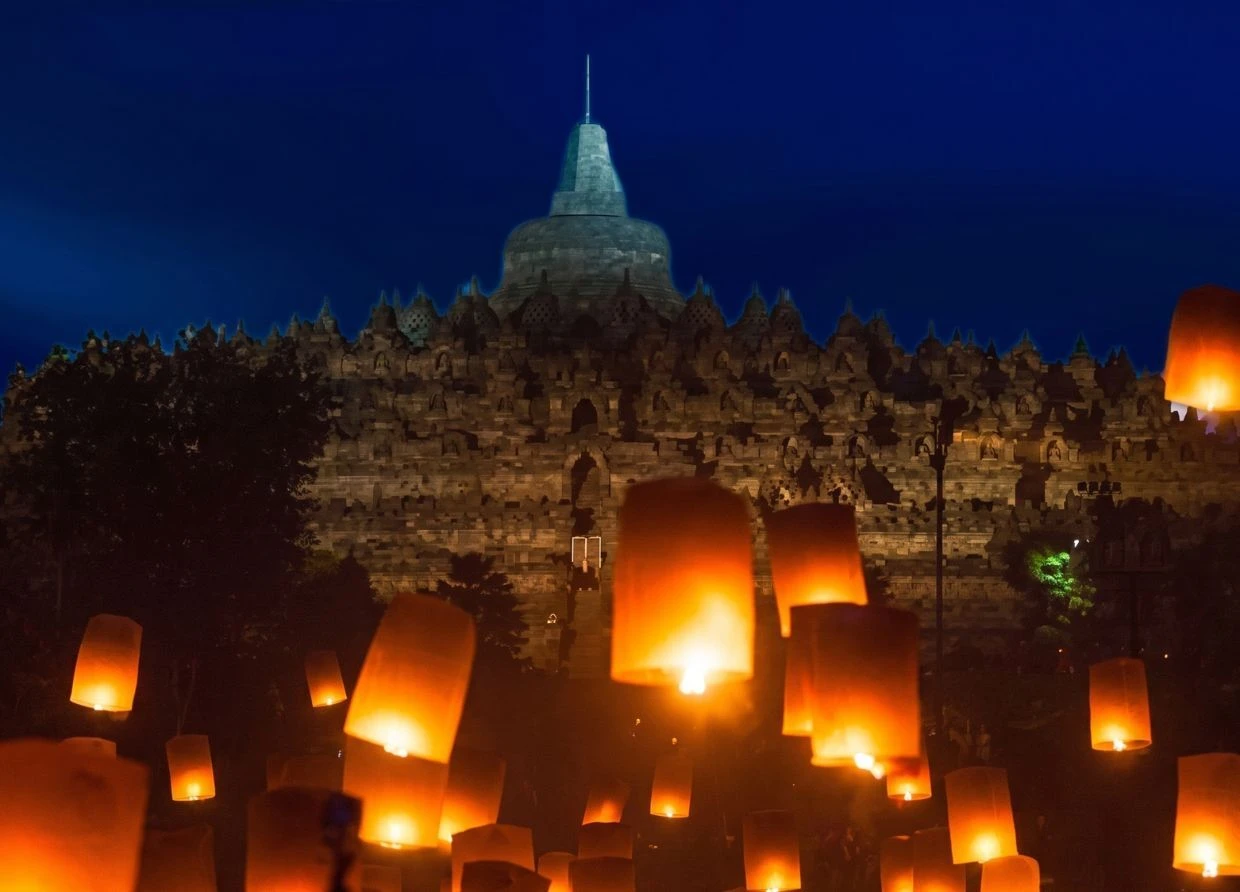





At 10 p.m. on Sunday, May 31, the second lantern release session at Lapangan Marga Utama reached full glow. One by one, then all at once, hundreds of white paper lanterns rose from Taman Lumbini into the warm Magelang night. No music. No announcement. Just the soft crackle of flame and the collective exhale of thousands of people looking up.
This is the Festival Lampion Waisak — and in 2026, it became the defining image of a holy day that draws both devout Buddhists and curious first-timers to one of the world's greatest archaeological sites.
What is the Festival Lampion Waisak at Borobudur ?
The Festival Lampion Waisak is the ceremonial lantern release that marks the peak of Tri Suci Waisak celebrations — the Buddhist commemoration of the birth, enlightenment, and death of Siddhartha Gautama. In 2026, the event was held on Sunday, May 31 at Lapangan Marga Utama and Taman Lumbini, within the Taman Wisata Candi Borobudur complex in Magelang, Central Java. Tickets started at Rp 65,000 for spectators, while full participation packages — which included a lampion, a wishing card, and access to the grounds — were available at higher tiers. The event was open to all, regardless of religion or background.
The 2026 festival ran under the theme "Lentera Perdamaian" (Lanterns of Peace), organized by the Perwakilan Umat Buddha Indonesia (Walubi) and Majelis Agama Buddha Mahanikaya Indonesia (MBMI). The exact Waisak moment fell at 15.44.44 WIB — a lunar-precise second calculated each year.
What happened on the night of May 31?
The day began before dusk with the penukaran tiket window from 09.00 to 19.00 WIB at Pintu Kampung Seni Borobudur. Before any lantern touched the sky, Buddhist devotees completed the kirab — a sacred procession from Candi Mendut to Candi Borobudur carrying holy water and the eternal flame from Candi Pawon. The procession is not a performance. It is puja bakti: active prayer.
The Dharmasanti ceremonial ran from 19.30 to 22.00 WIB at Taman Lumbini — a formal Waisak 2570 B.E. program featuring spiritual leaders including Bhiksu Lopon Dorji Sherab, Bhiksuni Rev. Ervinna Myoufu, and meditation teacher Hendrick Tanu. The lantern releases flanked this program: the first session from 17.30 to 19.30, the second from 21.30 to 23.00.
Who can join — and what's the surprising rule?
Here's what most people don't know before they show up: you don't release your lantern alone. Each lampion requires a minimum of four people to hold and release it properly. Solo attendees were paired with other participants by the panitia on the night. It sounds like a logistical footnote, but in practice it becomes the most unexpectedly intimate moment of the evening — standing in the dark with strangers, holding fire together.
Dress code: white clothing, strongly encouraged. Minimum age: seven years old. Participants were required to use official lampions provided by organizers — no personal lanterns from outside the venue were permitted. Every ticket already included the wishing card and lampion unit, no separate purchase needed.
Why does this festival matter beyond the photos?
The lampion is not a prop. In Buddhist tradition, releasing a lantern symbolizes the active process of letting go — of dukkha (suffering), negative thought, and karmic weight. The act is called Pelepasan Lentera Perdamaian, and the ritual intention is embedded in the wishing card written before the release. What tourists photograph as a spectacle, practitioners experience as prayer made visible.
Candi Borobudur itself, a UNESCO World Heritage Site built in the 9th century under the Sailendra dynasty, provides the context that no other venue on earth can replicate. The temple's 2,672 relief panels and 504 Buddha statues were designed as a mandala — a physical map of the path to enlightenment. Releasing a lamp above it is not incidental to the symbolism.