INDONESIA'S RAREST FLOWER JUST BLOOMED 25 TIMES IN ONE FOREST
Researchers found 25 Rafflesia bloom points in Kepulauan Anambas a first-ever documented population in the Riau Islands, spanning 47.5 hectares


A new population of Rafflesia undocumented until now has been found blooming deep inside the forests of Kepulauan Anambas, and researchers say the discovery changes everything.
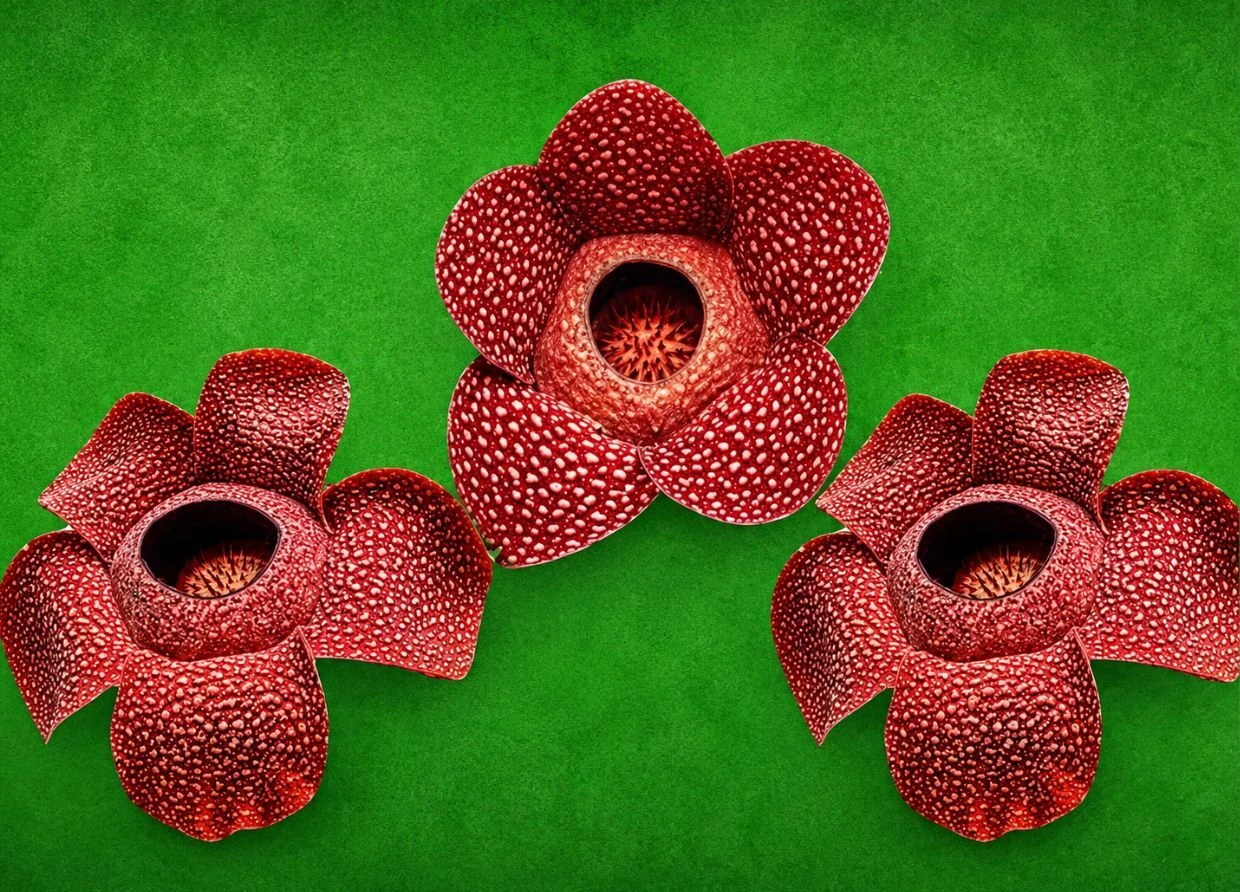
There is no smell quite like it. The Rafflesia the world's largest individual flower opens its five mottled petals to release an odour of rotting flesh, a trick to lure the carrion flies it needs to survive. It blooms for less than a week. Then it's gone.
Which is why what happened in the forests of Bukit Batu Tabir, in the village of Tarempa Selatan, Kepulauan Anambas, is so extraordinary. Researchers didn't find one Rafflesia. They found 25 of them spread across 47.5 hectares of intact lowland rainforest and not a single one had ever been recorded before.
What exactly is Rafflesia, and why does this discovery matter?
Rafflesia is a genus of parasitic flowering plants found only in the rainforests of Southeast Asia. It has no stems, no leaves, and no roots of its own it lives entirely inside the tissue of a host vine from the genus Tetrastigma, erupting above ground only when it blooms. In Indonesia, it is considered a national botanical treasure, alongside the Amorphophallus titanum (the titan arum). The largest species, Rafflesia arnoldii, can measure over a metre in diameter.
This latest finding is significant not just for its size but for its location. Kepulauan Anambas an archipelago in the Natuna Sea between peninsular Malaysia and Borneo had zero documented Rafflesia populations in the Riau Islands province. This is the first. Researchers from the local forestry network catalogued the 25 bloom points during a biodiversity survey, confirming a new population that had been quietly flowering, season after season, completely undetected.
How was this population of Rafflesia discovered?
The discovery came through a structured field survey of the Bukit Batu Tabir forest area a stretch of lowland forest that, by all accounts, had not been systematically studied for rare flora. The team found the 25 bloom points distributed unevenly across the 47.5-hectare zone, suggesting an established and reproducing population rather than isolated individuals. For a plant that takes months to develop underground before surfacing for a few days, finding this many active sites at once indicates the forest has been quietly supporting them for years.
Why is the Rafflesia under threat and what happens next?
The same researchers who made the discovery have issued a warning. Habitat destruction, uncontrolled ecotourism, and the loss of Tetrastigma host vines are the three biggest threats to Rafflesia populations across Indonesia. The plant cannot be cultivated outside its natural habitat. Once a host vine is cut by a machete, a hiking boot, a road — the Rafflesia inside dies with it, invisibly, weeks before anyone would notice.
Anambas has real potential as an ecotourism destination. A blooming Rafflesia draws visitors, photographers, researchers. But that interest, without strict management, becomes its own kind of threat. Indonesia has seen it happen before at sites in West Sumatra and Bengkulu: the flower becomes famous, the trail becomes crowded, and within a season or two the population collapses.
The priority right now, according to the researchers, is protection first — keeping the forest intact, mapping the host vine network, and putting formal conservation protocols in place before any tourist infrastructure is developed. Rafflesia is a living indicator of ecosystem health. Where it blooms, the forest is, for now, still whole.