THE EUROPEAN FINGERPRINTS HIDDEN ACROSS INDONESIA
How Europe shaped Indonesian culture from Keroncong's Portuguese roots to Kota Tua's Dutch architecture. A hidden history hiding in plain sight.





Most Indonesians grew up hearing Keroncong on the radio without ever wondering why it sounds faintly like something from Lisbon. That question leads somewhere surprising.
Across the Indonesian archipelago, traces of centuries-old European contact are hiding in plain sight in a music genre, a village name, a colonial-era town square, and a mansion that refuses to belong to just one culture.
What Is Keroncong and Where Did It Come From ?
Keroncong is one of Indonesia's oldest and most beloved music genres, recognizable by its gentle, plucked string sound and slow, melodic rhythm. It originated from Portuguese musical influences introduced to the archipelago in the 16th century, when Portuguese traders and sailors settled in coastal towns and brought their instruments with them.
Over generations, those Portuguese sounds blended with Javanese and other local traditions to create something entirely new. The cak and cuk small ukulele-like instruments central to Keroncong evolved directly from the cavaquinho, a small string instrument still played in Portugal today. Same roots, completely different soul.
Where Is Kampung Belgia and Why Does It Exist?
In Jember, a city in East Java, there is a neighborhood that locals still call Kampung Belgia the Belgian Village. It was developed in the early 20th century around a rubber plantation owned by Belgian investors, part of the broader colonial agricultural economy that transformed East Java's landscape.
The colonial owners are long gone, but the name and the architectural memory remain. Walking through Kampung Belgia today feels like a quiet historical accident a European footnote embedded in an Indonesian neighborhood.
The 1710 Building That Became Jakarta's Most Visited Museum
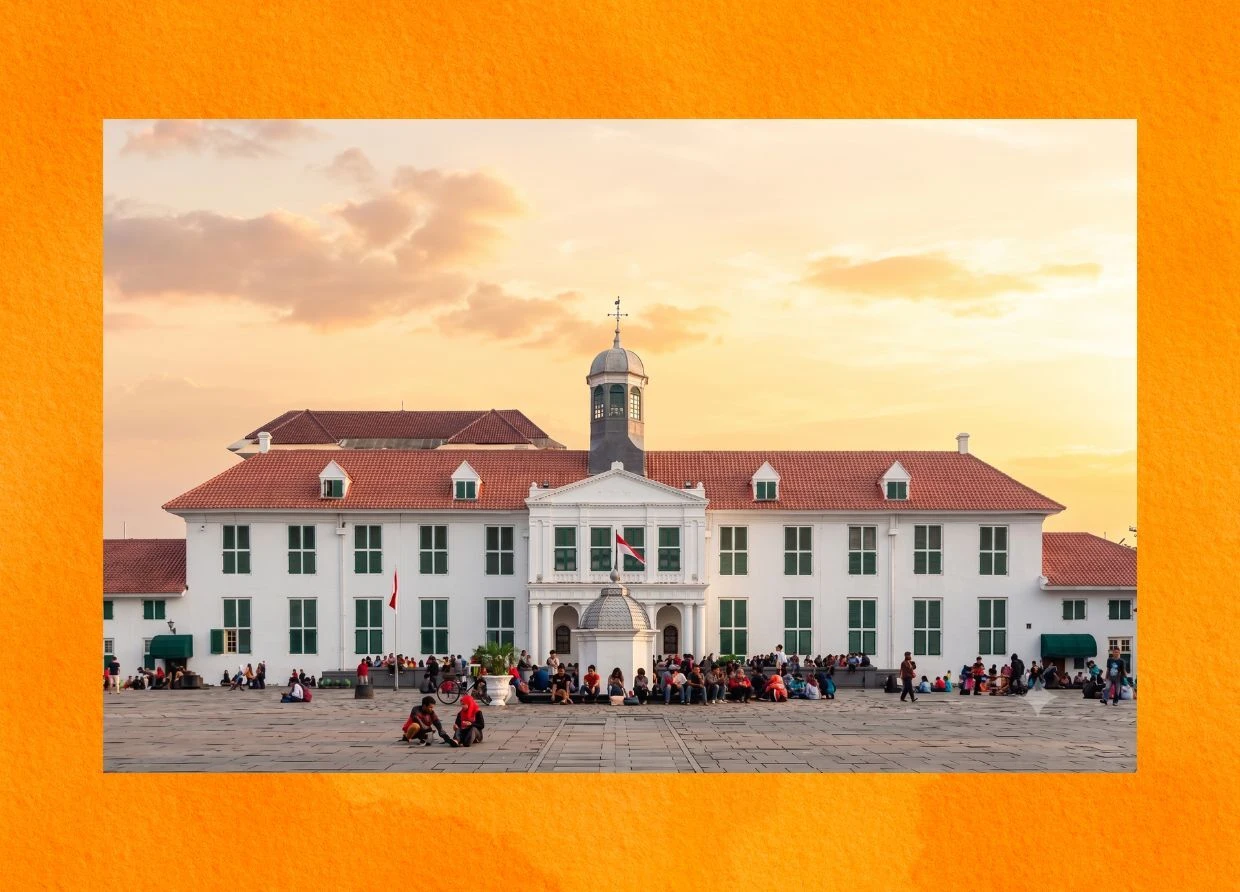
Standing on Taman Fatahillah Square in Kota Tua, the Stadhuis van Batavia or City Hall of Batavia was built in 1710 as the administrative center of the Dutch East Indies. Its full Dutch name, Gouverneurskantoor, translates simply to "Governor's Office."
Today it operates as the Jakarta History Museum. The building's white neoclassical facade has appeared in countless Instagram grids, but few visitors stop to think about what it was designed to represent: the center of Dutch colonial power in Southeast Asia. The square it faces was once used for public executions.
"This building didn't just survive history it absorbed it," said one local historian who leads walking tours of Kota Tua.
What Makes Tjong A Fie Mansion Different From Any Other Heritage Site?
Located in Medan, North Sumatera, Tjong A Fie Mansion is the rare kind of building that tells three stories at once. Built in the early 20th century by a Chinese-born merchant who became one of Medan's most powerful figures, the mansion blends Chinese, Malay, and European architectural styles under a single roof.
The ornate wooden doors, the wide European-style veranda, the Malay roof details nothing here was accidental. Tjong A Fie deliberately built a space that spoke every cultural language of the city he helped build. Medan was a multicultural trading hub, and his mansion was its clearest physical argument.
Why Does Any of This Matter Now?
Indonesia and the European Union share more than diplomatic agreements. They share centuries of entangled culture one that was often unequal and colonial in origin, but which produced music, neighborhoods, and buildings that Indonesians have fully claimed as their own.
Keroncong is not Portuguese music. Kota Tua is not a Dutch city. Tjong A Fie Mansion is not a European building. They are Indonesian shaped by contact, transformed by time.